Between home turf and Hinterland: Directly elected MPs focus more on local and deprived places than list candidates on social media
Jan 1, 2026·
,
,
,
·
0 min read
Birkenmaier, Lukas
Stroppe, Anne-Kathrin
Wurthmann, L. Constantin
Sältzer, Marius
Abstract
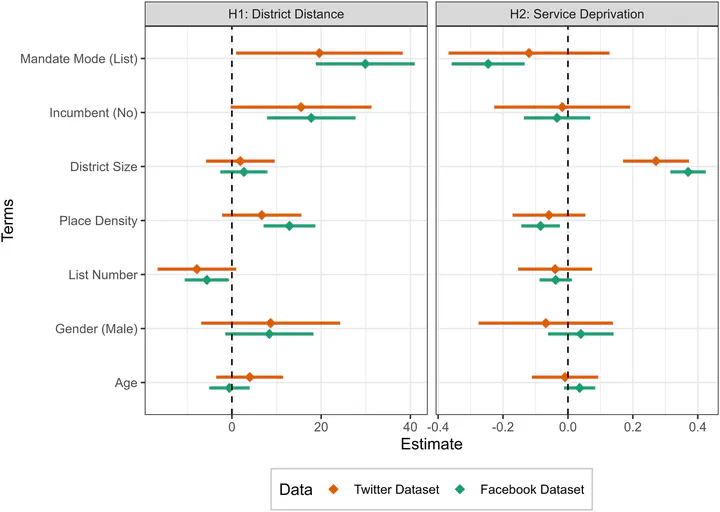
Geographic representation is a central feature of democracies: elected politicians are expected to speak and act on behalf of their constituency. Yet, politicians differ in how strongly their communication and behavior reflect territorial attachments, for instance, in mixed-member proportional systems. This study examines these differences using a two-dimensional measure of geographic representation that captures both the localness of referenced places, that is, their proximity to an MP’s constituency, and their deprivation, that is, their lack of access to essential public services. Using named entity recognition and Wikidata linkage in a novel and scalable pipeline, we analyze over 50,000 tweets and 190,000 Facebook posts by all members of the 19th German Bundestag (2017–2021). Our results reveal a clear mandate effect: via district elected MPs refer to locations closer to their constituencies and mention deprived areas within constituencies more often than list MPs. Overall, the study advances our understanding of geographic representation and showcases the potential of computational text analysis for studying spatial aspects of political behavior.
Type
Publication
Research & Politics (online first)